
In commercial cold storage logistics, relying on isolated USB data loggers and manual spreadsheets is an operational gamble that regularly results in catastrophic product loss. When a distributor loses a high-value pallet of perishable produce due to an undetected refrigeration drift, the inability to distinguish between an open door, a failing compressor, or a faulty probe creates immediate compliance friction and financial liability. Modern industrial facilities require real-time, deterministic monitoring that integrates directly into existing building operations rather than living inside another proprietary software silo.
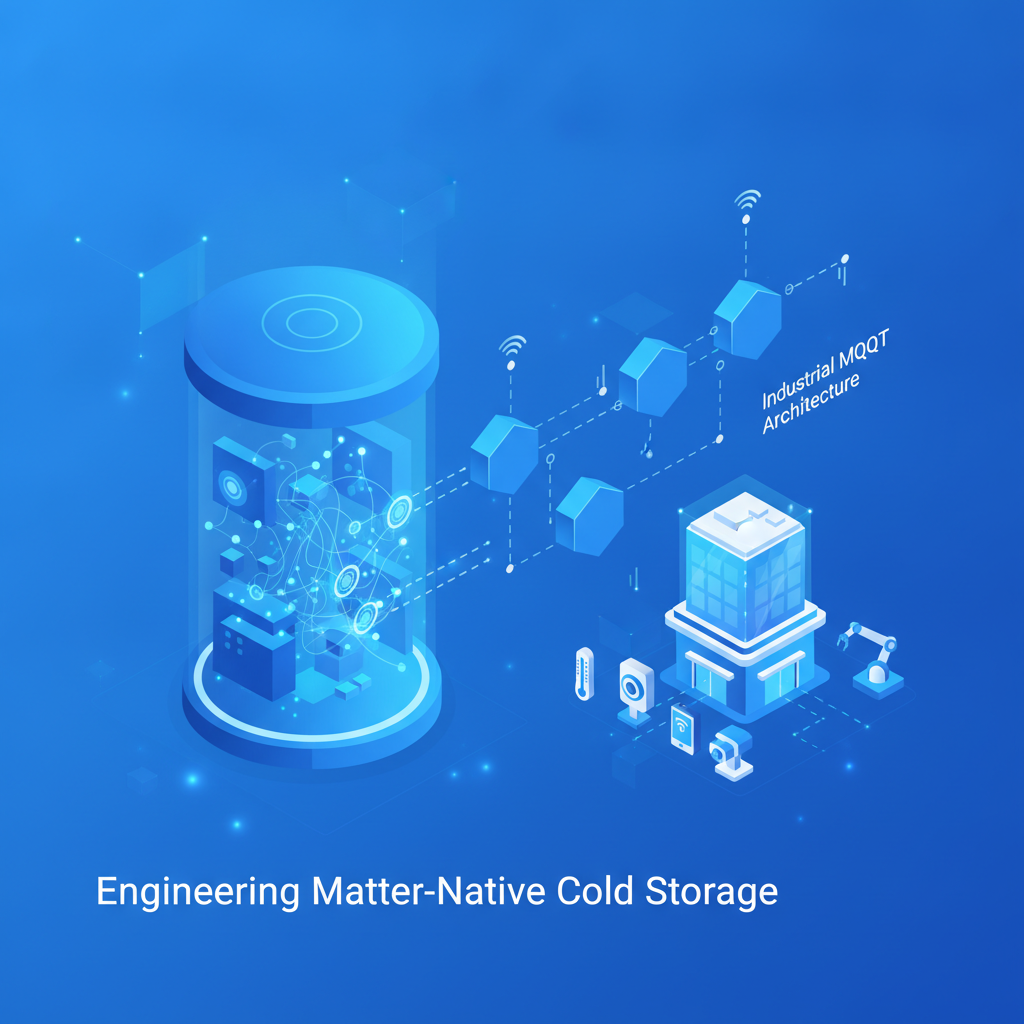
By deploying embedded sensor nodes running Matter over Thread paired with edge-to-cloud MQTT bridges, facilities can bridge the gap between commercial automation frameworks and mission-critical telemetry. This technical deep dive explores the hardware, firmware, and protocol decisions behind a successful multi-room cold storage pilot designed to achieve sub-minute alarm notifications, strict compliance logging, and seamless ecosystem convergence.
The Cold Chain Dilemma: Beyond Standalone Data Loggers
Industrial cold storage rooms operating from -25°C to +15°C leave zero margin for unmonitored temperature excursions. Facility teams frequently operate with fragmented systems where HVAC runs on legacy building controls, while refrigeration units operate on closed OEM loops, leaving ambient condition tracking to standalone battery loggers. When an excursion occurs overnight, the lack of real-time telemetry prevents remediation before biological spoilage sets in.
To solve this, modern instrumentation must meet rigid service-level agreements: bi-directional alerting within 60 seconds of a threshold breach, local zero-power visual status confirmation for floor operators, and persistent offline ring-buffering. Most importantly, enterprise operators require new sensor deployments to ingest natively into their primary building management controllers without forcing field technicians to juggle secondary apps or proprietary cloud subscriptions.
Embedded Hardware Design: Thermal Isolation and Power Resilience
The sensor node hardware was architected around the Nordic nRF52840 System-on-Chip (SoC), selected for its native Thread radio capabilities, robust memory allocation for the Matter stack, and low-power sleep modes. Primary ambient metrics are captured using a Sensirion SHT45 digital sensor delivering ±0.1°C accuracy, supplemented by dual external DS18B20 digital probes routed directly to evaporator coils and door thresholds to isolate specific operational failure points.
A critical engineering challenge in high-accuracy cold storage telemetry is parasitic board heating. Initial PCB revisions revealed a 0.8°C thermal offset caused by copper plane heat transfer from onboard power conversion circuitry. Resolving this required strict physical isolation: routing an air-gap slot in the 4-layer KiCad design around the copper pour hosting the SHT45, eliminating thermal conduction from the power regulation stages. For local user interface needs, a 2.9-inch electronic paper (e-paper) panel was implemented, maintaining the last sampled temperature, humidity, and alarm state indefinitely with zero static power consumption.
Firmware Architecture: Zephyr RTOS and Cluster Customization
Running on Zephyr RTOS, the node firmware cleanly separates sampling threads, attribute updates, and local alarm evaluation. Environmental metrics are sampled every 30 seconds and fed through a three-stage rolling median filter to suppress spurious transients caused by routine warehouse door operations. Alarm triggering employs a 2.0°C hysteresis band with a 0.5°C recovery threshold, preventing alarm chattering when the space operates near setpoint boundaries.
At the network layer, standard Matter clusters (Temperature Measurement and Relative Humidity Measurement) handle primary space variables, while evaporator and seal probe readings map to custom vendor clusters. Crucially, Matter’s default subscription intervals proved too latent for industrial food safety compliance. Tuning the minimum and maximum reporting bounds down to 30 and 60 seconds within the data model ensured that controller-side alerts dispatched well within the target performance envelope without saturating Thread mesh throughput.
The Protocol Bridge: Ingesting Matter and Thread into Enterprise BMS
While Matter provides interoperability at the controller level, multi-site industrial cold storage operations depend on centralized, supervisory data orchestration. An ESP32-S3 edge bridge acts as a Thread Border Router while simultaneously republishing telemetry outward via MQTT over TLS. To protect against WAN outages, the bridge maintains a 30-day local ring buffer in non-volatile flash, executing an automated data backfill upon link restoration.
In enterprise facilities, cold chain data cannot remain isolated from the broader mechanical plant. Bridging MQTT-based environmental telemetry with legacy plant infrastructure—such as chillers controlled over BACnet or Modbus power meters—is where platforms like BAaaS.io deliver operational leverage. By operating as a cloud-native Building Automation as a Service platform, BAaaS.io normalizes inbound high-throughput MQTT streams alongside BACnet/IP, Modbus, LonWorks, KNX, and LoRaWAN, giving engineers unified supervisory control and cross-protocol closed-loop automation without the overhead of localized head-end servers.
Pilot Validation: Latency, Diagnostics, and Field Commissioning
During a six-week pilot across four commercial cold rooms deploying twelve nodes, the system verified an average threshold-to-notification latency of 38 seconds. The deployment diagnosed two critical anomalies prior to inventory loss: an extended defrost heater cycle running beyond standard operating parameters in one chamber, and a failing perimeter door gasket that presented as a subtle, progressive humidity increase across a 72-hour window.
Field commissioning validated the operational benefit of standards-based integration. Because the nodes implemented native Matter data clusters, facility technicians onboarded each unit into their existing facility controllers in less than ten minutes per zone via standard commissioning flows. Eliminating bespoke field configuration tools significantly reduces the time-to-value for commercial cold storage retrofit projects.
Conclusion
Building a Matter-native cold storage monitor demonstrates that modern consumer and commercial IoT protocols can reliably serve mission-critical industrial monitoring when combined with rigorous embedded design. While pure MQTT-over-Wi-Fi architectures remain a rapid path for standalone monitoring products, Matter over Thread provides low-power mesh resilience and eliminates dashboard fragmentation when an existing controller infrastructure is in place. As edge hardware continues to evolve, unifying these edge sensors into comprehensive platforms like BAaaS.io ensures that cold chain integrity, energy efficiency, and building automation operate within a singular, secure management ecosystem.