
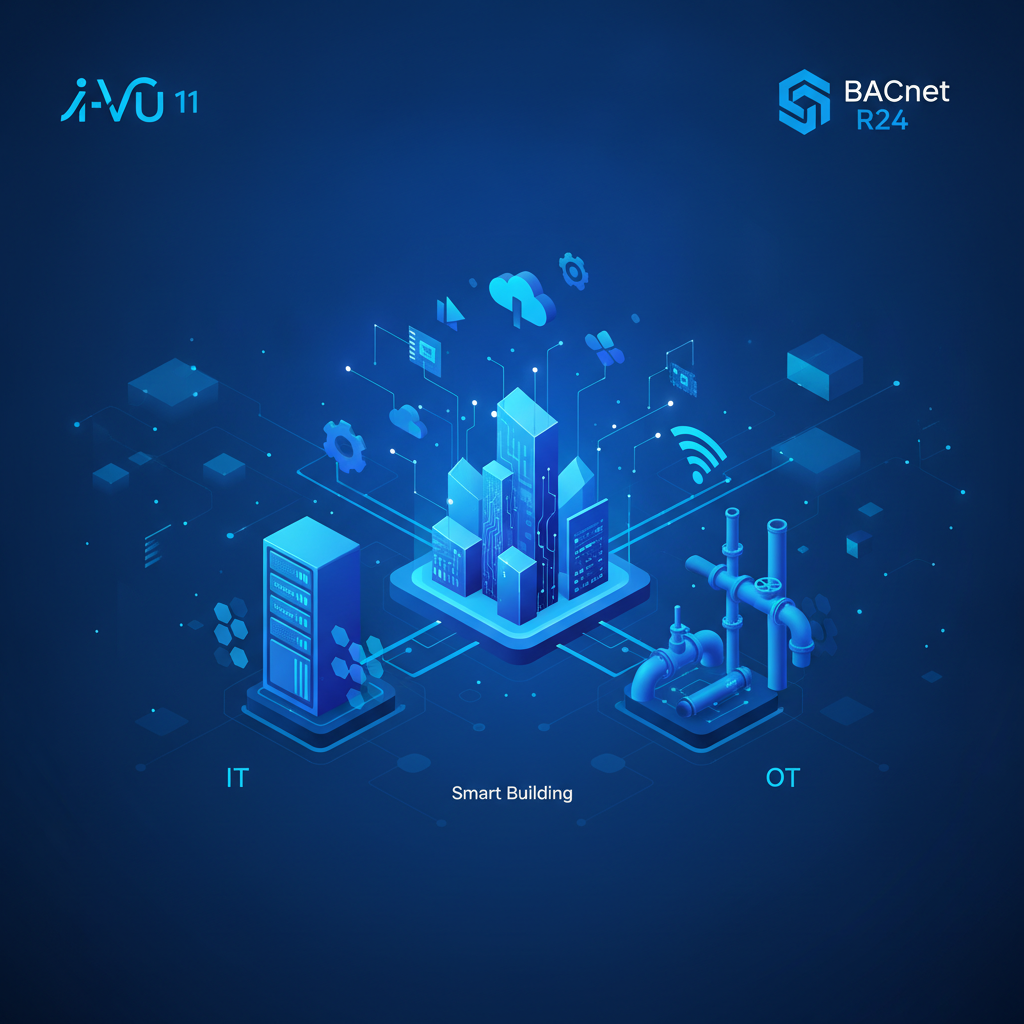
Commercial facility operations face an increasingly urgent architectural challenge: building automation systems (BAS) must balance complex mechanical controls with modern enterprise cybersecurity and intuitive operator interfaces. Carrier’s release of the i-Vu 11 platform addresses these operational pain points directly, introducing certified BACnet Protocol Revision 24 compliance, native IT-centric security tooling, and relationship-based navigation.
For facility executives, systems integrators, and building engineers, this update signals a vital shift across the industry. Proprietary boundaries and isolated operational technology (OT) silos are dissolving in favor of rigorous open-standard adherence and unified IT/OT visibility.
BACnet Protocol Revision 24 and Certified B-OWS Compliance
Carrier’s certification as a BACnet Operator Workstation (B-OWS) under BACnet Protocol Revision 24 represents a critical benchmark for open, multi-vendor building management. Revision 24 deepens support for advanced data modeling, modern alarm management, and strict conformance testing, ensuring operators can manage multi-vendor field equipment—from central chiller plants to variable air volume (VAV) terminal units—without protocol impedance or lost point attributes.
This adherence to open standards reinforces that enterprise building operations cannot afford proprietary vendor lock-in. While on-premises workstations like i-Vu strengthen device-level adherence, modern enterprise facilities increasingly pair these supervisory engines with cloud-native architectures. Platforms like BAaaS.io build upon standardized BACnet foundations to harmonize field devices alongside Modbus, KNX, LonWorks, LoRaWAN, and MQTT, bridging legacy mechanical assets and cutting-edge IoT telemetry into a single operational interface.
Hardening ICS Security Through Native Syslog Integration
One of the most consequential enhancements in the i-Vu 11 release is native syslog support, directly tackling the long-standing disconnect between facilities management and enterprise IT security teams. Historically, industrial control system (ICS) security events, unapproved setpoint alterations, and unauthorized access attempts remained trapped inside isolated supervisory workstations.
By streaming standardized syslog events directly to corporate Security Information and Event Management (SIEM) tools such as Splunk or Microsoft Sentinel, security operations centers (SOCs) obtain unified visibility across both IT and OT networks. This proactive integration allows facilities teams to flag brute-force authentication attacks, abnormal configuration writes, and network anomalies before they lead to operational downtime or compromised physical safety.
Contextual Architecture: The Shift to Relationship-Based Navigation
Traditional building automation interfaces rely heavily on rigid, nested tree structures that force technicians to hunt through complex directory layers to correlate interconnected equipment. Carrier addresses this friction by introducing relationship-based system navigation, visually connecting parent-child mechanical dependencies such as which primary chilled water loops feed specific air handlers and downstream thermal zones.
This topological, relationship-first navigation significantly reduces mean-time-to-resolution (MTTR) during system alarms and tenant hot/cold calls. As commercial spaces advance toward digital twins and automated environmental orchestration, context-rich indexing becomes foundational. Modern cloud platforms such as BAaaS.io expand on this concept by correlating mechanical assets, room-level wireless occupancy sensors, and energy submeters into a unified semantic model, allowing operators to diagnose root causes across all building protocols in seconds.
Conclusion
The modernization of Carrier’s i-Vu platform reflects where the smart building industry is heading: open protocol compliance, uncompromising IT/OT cybersecurity, and intuitive, relationship-first workflows. As building automation systems become core pillars of enterprise digital resilience and ESG strategies, deploying software that speaks native BACnet while adhering to enterprise IT security standards is no longer an optional upgrade—it is the baseline for resilient, future-ready facilities.