
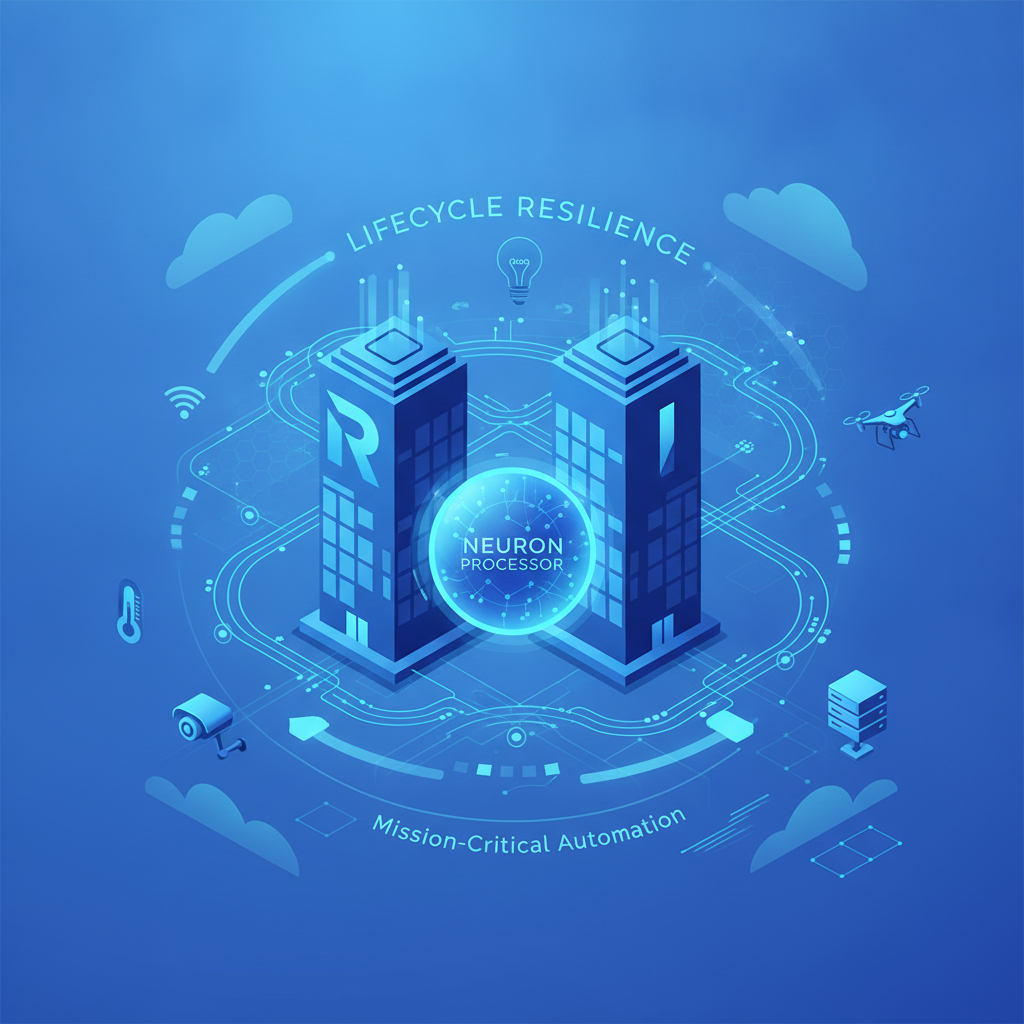
For more than two decades, the Neuron processor has served as the deterministic silicon bedrock of LonWorks networks across commercial facilities, transit hubs, and industrial automation plants. The extended support agreement between Rochester Electronics and Infineon Technologies—governed under the TLS360 program—marks a significant milestone for building automation architects and industrial control specialists tasked with managing aging yet critical infrastructure.
By ensuring authorized, continuous availability of key processor families such as the CY7C53150 and CY7C53120, this partnership removes the looming threat of premature end-of-life (EOL) disruptions. In critical operational technology (OT) environments like elevator banks, sub-stations, and pharmaceutical cleanrooms, replacing fully functional, code-compliant controllers simply because silicon is deprecated is rarely technically necessary or financially justifiable.
The Enduring Dominance of Neuron Silicon in Operational Technology
Neuron processors were explicitly engineered for distributed control, housing three independent processing cores dedicated to media access, network transport, and user application logic. This proprietary architecture formed the backbone of LonWorks (ANSI/CEA-709.1) communication, delivering peer-to-peer determinism over twisted-pair (FT-10) wiring that few contemporary fieldbus architectures could match at scale.
Because these processors execute validated LonMark functional profiles, they maintain consistent, predictable operation inside critical building systems that have operated continuously for decades. The CY7C53150 and CY7C53120 families remain entrenched in millions of active field controllers worldwide, serving as reliable edge computing nodes that require zero intervention beyond routine mechanical maintenance.
Mitigating Counterfeit Risks and Capital Waste Through Lifecycle Governance
When legacy microcontrollers reach obsolescence, industrial operations often face an agonizing tradeoff: undertake expensive, disruptive controller redesigns or gamble on unverified brokers within the grey semiconductor market. In regulated sectors such as life safety, elevator dispatching, and critical manufacturing, deploying unverified or refurbished silicon introduces catastrophic failure risks and invalidates safety certifications.
The Rochester TLS360 framework directly addresses this vulnerability by delivering 100% genuine, authorized components sourced under factory agreements with original manufacturers like Infineon. Facility engineers and original equipment manufacturers (OEMs) retain the ability to manufacture replacement I/O boards, VAV controllers, and chiller interface modules without rewriting millions of lines of proven assembly and Neuron C firmware.
Harmonizing Legacy LonWorks with Modern Cloud Management Architectures
While extended silicon availability secures the physical fieldbus layer, modern enterprise facilities require unified visibility, remote management, and advanced cybersecurity that legacy 1990s head-end software cannot provide. The modern engineering challenge is not replacing deterministic FT-10 networks, but liberating their operational telemetry from obsolete, on-premises supervisory servers and proprietary workstations.
This is where modern platforms bridge the gap between operational longevity and digital transformation. Platforms like BAaaS.io enable building owners to preserve their reliable, Neuron-driven field devices while modernizing the supervisory layer. By natively supporting LonWorks (LonWorks/IP-852 and FT-10) alongside modern protocols like BACnet, Modbus, KNX, LoRaWAN, and MQTT, BAaaS.io normalizes legacy controller points into an edge-to-cloud management ecosystem without requiring disruptive rip-and-replace retrofits.
Through this hybrid approach, facilities can leverage the long-term hardware availability provided by Rochester and Infineon while upgrading their central operations to include automated fault detection, dynamic energy optimization, and zero-trust cloud security natively.
Conclusion
The extended support for Neuron processors by Rochester Electronics and Infineon proves that legacy reliability and modern automation can coexist. For engineering leaders and building managers, this longevity eliminates the pressure of artificial upgrade cycles, preserving validated control logic while protecting capital budgets. When combined with next-generation cloud platforms that integrate legacy fieldbus protocols into modern digital twins, facility executives achieve the optimal balance: decades-long field reliability at the device level, paired with enterprise agility at the supervisory layer.