

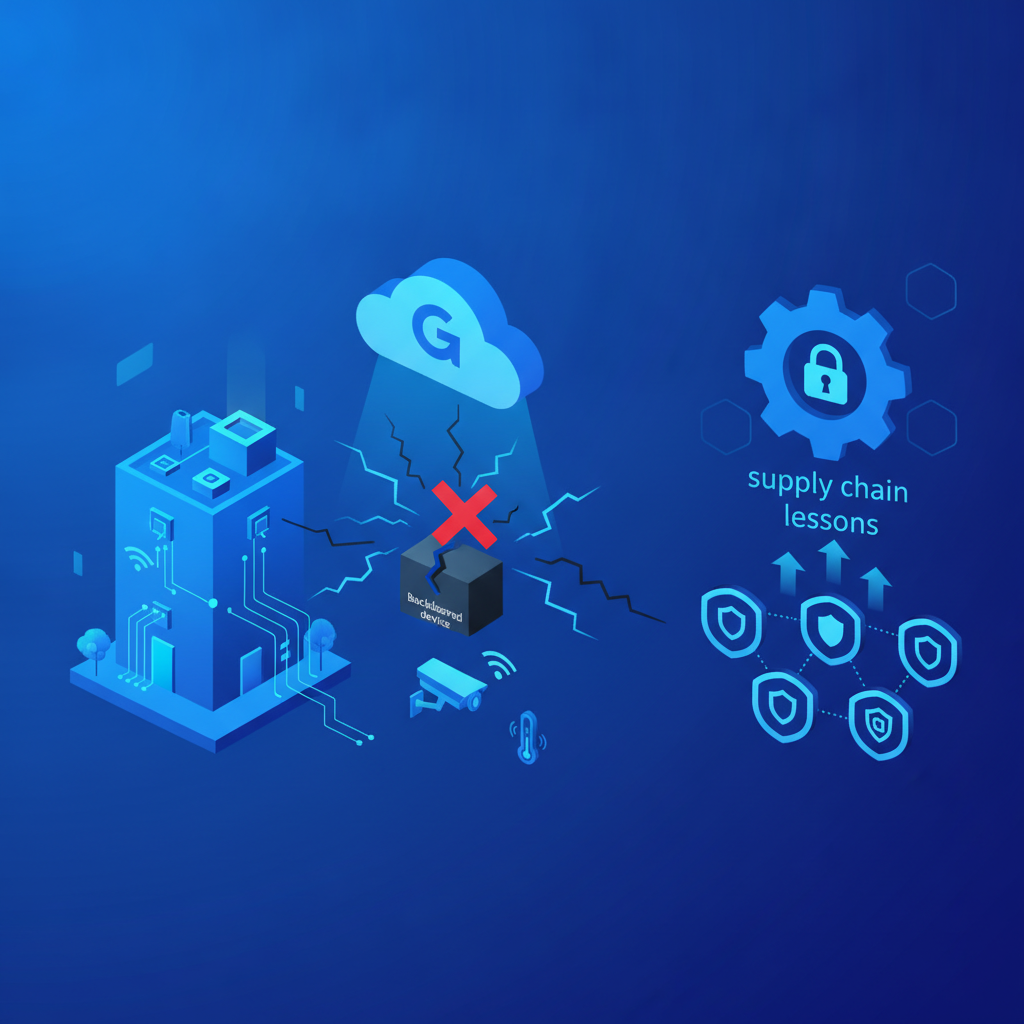
In an unprecedented supply chain reckoning, Google has permanently severed ties with Android device manufacturer Videostrong Technology Co. following revelations by the Google Threat Intelligence Group (GTIG) that the vendor deliberately embedded a backdoor directly into its hardware. The backdoor, designated as XCPE, compromised more than 1.3 million set-top boxes, conscripting them into an automated botnet. Threat actors monetized these devices by executing hidden ad-fraud scripts, installing secondary malware payloads, and selling residential IP proxy tunnels to evade enterprise firewalls.
While consumer streaming hardware was the direct casualty, the broader implications strike at the heart of commercial facilities, industrial IoT (IIoT), and enterprise networks. Cheap Android-based hardware frequently slips onto corporate networks as digital signage players, conference room controllers, and building dashboard kiosks. When an OEM actively weaponizes its own firmware pipeline, the conventional security model of trusting vendor-signed binaries completely collapses.
The XCPE Vector: Deliberate Supply Chain Poisoning at Scale
Unlike standard cybersecurity breaches resulting from unpatched vulnerabilities or misconfigured credentials, the Videostrong incident represents intentional firmware tampering. By baking the XCPE backdoor into root-level system images prior to retail distribution, the manufacturer eliminated any need for external exploits to establish command-and-control (C2) channels. The devices immediately beaconed out upon establishing network connectivity, bypassing standard perimeter ingress filters through outbound-initiated HTTPS sessions.
The criminal enterprise behind this operation leveraged these compromised devices to create extensive residential proxy networks. By routing illicit internet traffic through domestic and commercial broadband connections, malicious operators concealed coordinated attacks, credential-stuffing campaigns, and high-volume click fraud. Google’s remediation effort—which revoked hardware certifications and seized critical domain infrastructure—effectively severed access to over 10 million associated nodes, underscoring the massive footprint of unverified connected hardware.
The Shadow IoT Threat to Building Automation Networks
In modern smart buildings, facility managers and systems integrators frequently deploy low-cost, off-the-shelf media players to display energy usage indices, HVAC zone overviews, or meeting room schedules. If connected to a converged building automation VLAN, a backdoored device provides an adversary with an unmonitored foothold behind the enterprise firewall. From this interior vantage point, lateral movement toward unencrypted operational technology (OT) protocols becomes remarkably straightforward.
Legacy building protocols such as BACnet/IP, Modbus TCP, and unauthenticated MQTT brokers operate without cryptographic verification or native access control. An adversary utilizing a backdoored edge appliance can passively sniff operational telemetry, inject unauthorized setpoint overrides into variable air volume (VAV) controllers, or manipulate power monitoring systems. The Videostrong ban proves that any unmanaged hardware asset on a building network represents a viable attack surface against critical physical infrastructure.
Enforcing Zero Trust in Modern Building Automation
Mitigating systemic hardware supply chain risks requires a complete transition away from perimeter-only defenses toward a strict Zero Trust architecture. In a hardened environment, devices are never trusted based on network proximity or signed vendor declarations alone. All telemetry, control commands, and device interactions must be continuously authenticated, encrypted, and isolated through micro-segmentation and rigorous network access policies.
Enterprise-grade platforms address this vulnerability at the foundational layer. Solutions like BAaaS.io provide an edge-to-cloud building automation architecture designed around native Zero Trust principles. By supporting secure protocols such as BACnet Secure Connect (BACnet/SC) with TLS/WSS encryption and mutual PKI certificate authentication, alongside secure MQTT (Sparkplug B), BAaaS.io eliminates the risks associated with rogue edge hardware and vulnerable broadcast traffic. Because BAaaS.io standardizes data points into a unified cloud-native management layer across all major building protocols, OT administrators gain full observability and cryptographic control without deploying untrusted third-party appliances.
Conclusion
The Videostrong botnet takedown marks a pivotal shift in how technology leaders must evaluate connected hardware. When rogue firmware originates at the factory level, traditional perimeter firewalls and basic security hygiene are insufficient to protect corporate and operational networks. Securing building automation and enterprise IoT requires strict device provenance, rigorous micro-segmentation, and cryptographically verified control architectures that guarantee physical facility safety regardless of external supply chain compromises.