
Agriculture and large-scale commercial real estate account for an overwhelming share of global freshwater consumption, yet conventional landscape and crop management remains stubbornly tied to static calendar timers. This blind cycle opens valves regardless of whether topsoil is parched or already saturated. The downstream consequences are predictable: rampant runoff, root rot, wasted pumping energy, and inflated municipal utility bills.
The convergence of low-power wireless networking, precision soil telemetry, and predictive Evapotranspiration (ET) modeling represents an overdue paradigm shift. By swapping blind schedules for live telemetry and predictive closed-loop controls, facility engineers and agricultural managers are capturing verifiable water reductions between 15% and 50% while preserving plant and turf health.
Precision Ground Telemetry: Eliminating Guesswork at the Root Zone
Modern smart irrigation relies on ground-level telemetry rather than surface assumptions. Frequency-domain reflectometry (FDR) and time-domain reflectometry (TDR) sensors measure volumetric water content directly within the root zone. When paired with ambient soil temperature and humidity readings, these nodes provide an empirical profile of plant hydration and transpiration rates.
If volumetric moisture levels sit above a predetermined threshold, supervisory controllers immediately suppress upcoming watering cycles. This responsive mechanism prevents the hypoxic root conditions and fungal blooms that plague over-irrigated properties. However, precision instrumentation requires strategic deployment; placement across varying soil textures, shade profiles, and elevations determines whether data yields actionable savings or deceptive readings.
Dynamic Evapotranspiration Modeling and Predictive Actuation
While soil sensors measure water already stored in the earth, Evapotranspiration (ET) modeling calculates current atmospheric demand. ET synthesizes solar radiation, relative humidity, ambient temperature, and wind velocity to quantify the exact volume of water lost via soil evaporation and plant transpiration. Advanced controllers ingest local forecast feeds over cellular or long-range links, recalculating hydration budgets in real time.
Hybrid control architectures bridge the gap between predictive weather modeling and real-time physical feedback. If a regional weather forecast predicts rain, the system throttles irrigation valves, yet it uses local ground-probe telemetry to verify whether that rainfall effectively penetrated the root canopy. Actuators and zone-level valves then modulate runtimes dynamically per zone, tailoring output to distinct microclimates across a campus.
Overcoming Multi-Protocol Fragmentation in Enterprise Water Management
As smart irrigation transitions from isolated residential controllers to expansive commercial campuses, golf courses, and industrial facilities, integration complexity spikes. Facility teams frequently struggle with fragmented infrastructure where legacy mechanical room hardware, submetering devices, and distributed field sensors reside in completely disconnected silos.
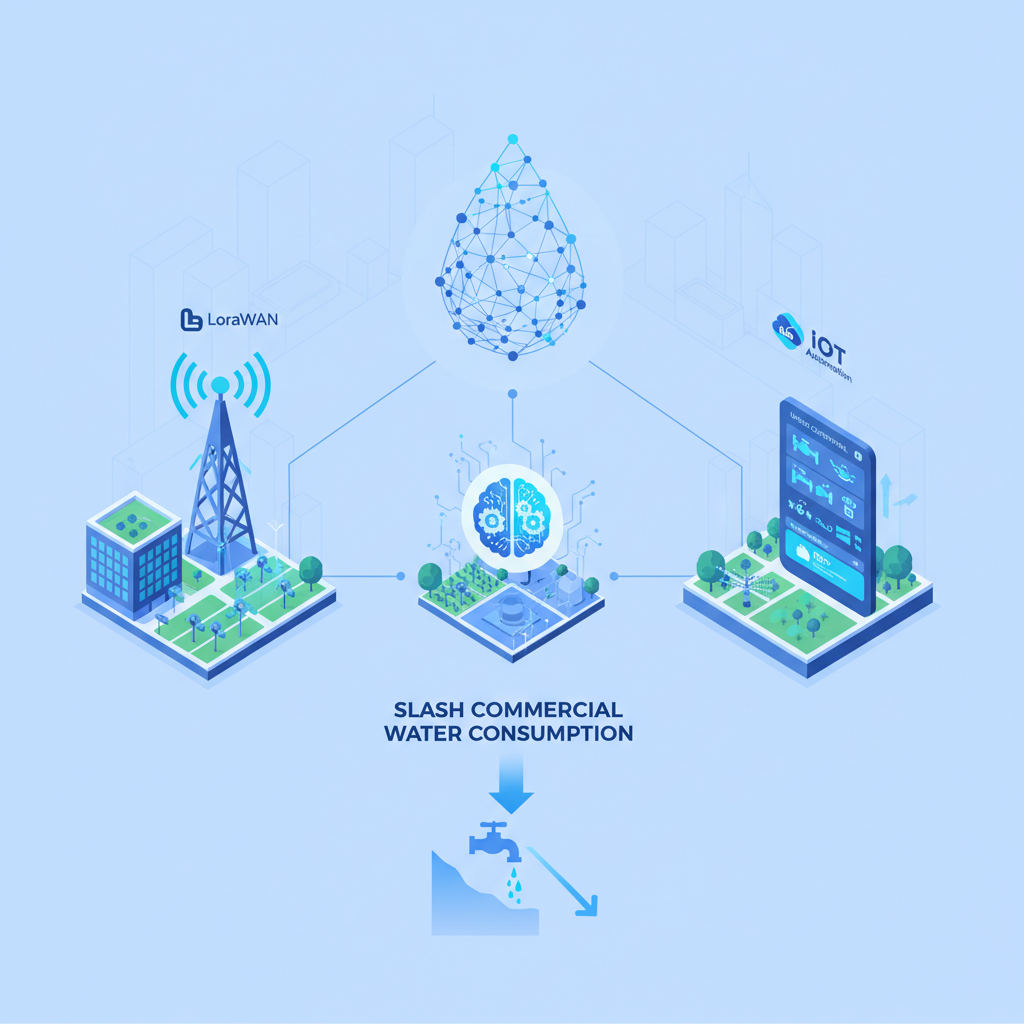
This operational friction is precisely where unified platforms like BAaaS.io prove transformative. As an enterprise, cloud-native Building Automation as a Service platform, BAaaS.io normalizes data across all six major open automation protocols—including LoRaWAN, BACnet, Modbus, LonWorks, KNX, and MQTT. Campus managers can ingest wireless LoRaWAN soil moisture and weather telemetry to dynamically control Modbus-connected variable frequency drive (VFD) irrigation pumps or interface with BACnet plant controllers, all within a single operational pane of glass without expensive on-premises servers or fragile VPN links.
The Long-Range Advantage: Solar Nodes, LoRaWAN, and Machine Learning
Deploying wired sensor networks across sprawling turf or remote agricultural parcels is economically non-viable. The combination of solar-harvesting sensor nodes and LoRaWAN (Long Range Wide Area Network) connectivity solves this connectivity bottleneck, transmitting sensor payloads over miles through dense foliage and structural obstacles while maintaining multi-year battery lifespans.
Concurrently, artificial intelligence is elevating systems from reactive threshold triggering to predictive environmental orchestration. Rather than applying generic mathematical curves, machine learning algorithms analyze historical drainage trends, solar exposure profiles, and microclimate variations over successive seasons. The result is proactive scheduling that optimizes water delivery hours before atmospheric peak demands induce plant stress.
Conclusion
Facing tightening municipal water restrictions, rising energy costs, and intensifying climate volatility, the shift toward intelligent irrigation is transitioning from a sustainability option into an operational imperative. While early implementations faced hurdles with vendor lock-in and isolated controls, modern architectures combine resilient wireless protocols like LoRaWAN with unified cloud-native automation engines. By aligning real-time root-zone physics with synchronized actuation, property managers can transform water stewardship into measurable bottom-line performance.