

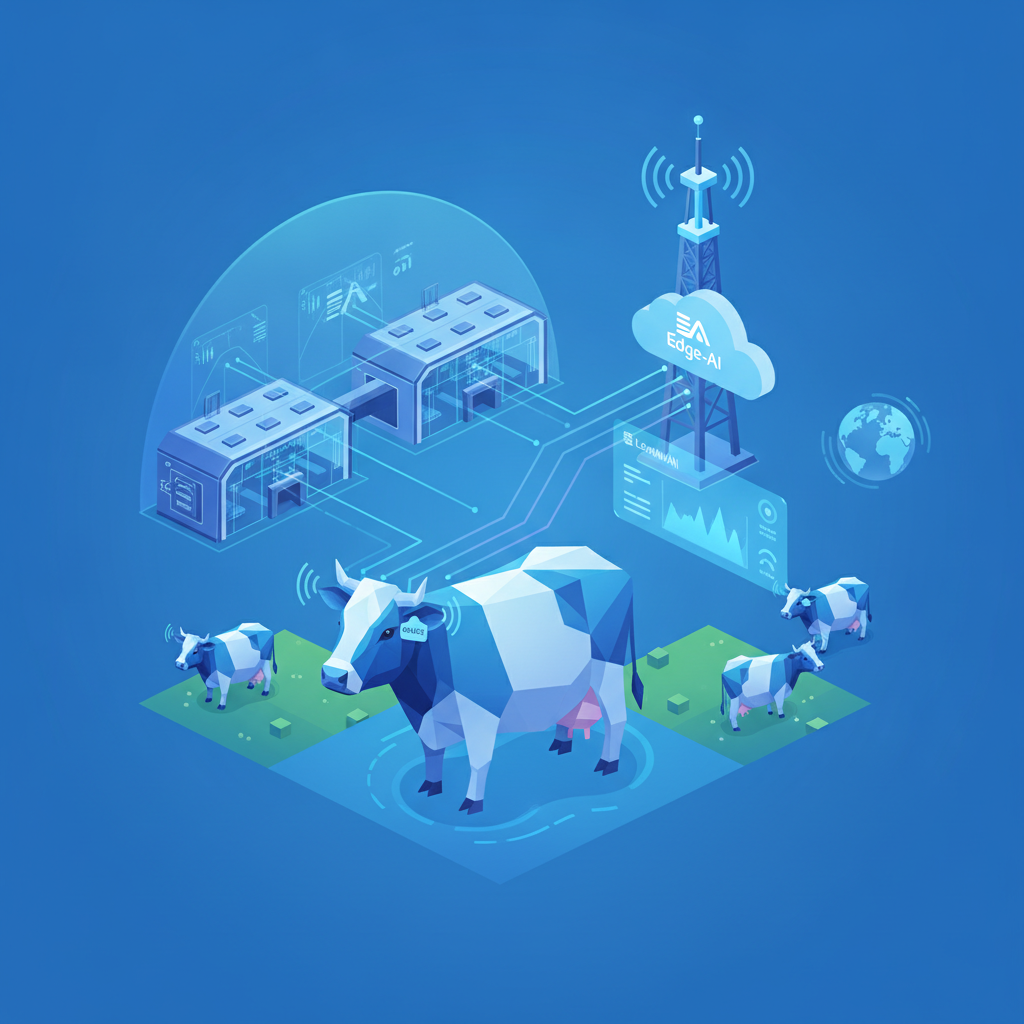
Methane emitted from enteric fermentation represents one of the agricultural sector’s most stubborn decarbonization hurdles. While macro-level estimates and herd-wide feed additives have long dominated abatement discussions, actionable mitigation requires high-resolution, animal-level data. A research team from Harvard has introduced an innovative hardware-software architecture known as the GRAZE-Tag: a compact electronic ear tag combining chemical sensing, embedded machine learning, and low-power wireless networking to track individual bovine methane emissions in real time.
By migrating signal processing directly to the edge, the system transforms intermittent breath plumes into verifiable greenhouse gas metrics. This capability bridges the historical gap between laboratory-grade breath sampling and scalable, commercial livestock management.
Edge Machine Learning in Harsh Ambient Environments
Industrial barns and pastures present extreme signal-to-noise challenges for environmental sensing. Atmospheric interference from ammonia, ambient humidity, bedding particulate, and silage fermentation typically distorts raw metal-oxide or optical gas measurements. The GRAZE-Tag overcomes this barrier by pairing micro-machined chemical sensors with embedded TinyML pattern-recognition models directly on an ultra-low-power microcontroller.
Rather than streaming raw, high-frequency voltage traces, the on-tag classifier evaluates the temporal signature of gas plumes adjacent to the animal’s nostrils. The model isolates short-duration eructation bursts from sustained ambient barn odors, computing clean methane volume calculations locally. Running periodic micro-scans and processing inference locally slashes transceiver duty cycles, ensuring extended battery operational lifespans under rugged farm conditions.
Wireless Ingestion and Smart Facility Orchestration
Once classified and timestamped at the edge, summarized payloads are transmitted over sub-gigahertz wireless architectures, primarily LoRaWAN. The propagation characteristics of LoRaWAN make it uniquely suited to span steel-framed barn infrastructure and expansive grazing acreage without requiring expensive, power-hungry cellular hardware on every animal.
These edge payloads pass through local LoRaWAN gateways to upstream industrial platforms for aggregation, time-series processing, and herd management integration. In modern agricultural operations, facilities increasingly resemble industrial automation plants, where biological telemetry intersects with automated ventilation, slurry management, and energy monitoring. Solutions like BAaaS.io demonstrate the value of this architectural model by natively harmonizing LoRaWAN sensor feeds alongside core industrial protocols like BACnet and Modbus, establishing a single operational pane of glass that bridges agricultural IoT devices with supervisory building automation systems.
Targeted Herd Interventions and Operational Returns
Capturing animal-level methane profiles fundamentally changes the economics of farm-level decarbonization. Historically, producers faced high operational expenditure when implementing blanket feed interventions across entire herds. Real-world pilots indicate that enteric methane output follows a Pareto distribution: a small subset of high-emitting animals often accounts for a disproportionate volume of overall emissions.
Granular data allows operators to isolate top emitters—for instance, targeted dietary changes on the highest-producing 10% of a herd achieved a 12% average methane reduction in early trials. Furthermore, unexpected emission spikes frequently correlate with subclinical rumen acidosis or metabolic dysfunctions. Identifying these variations before physical symptoms arise yields double dividends: reduced carbon intensity alongside sustained lactation yields and reproductive efficiency.
Data Integrity, Calibration, and Carbon Accounting
Translating wireless telemetry into institutional carbon credits or ESG lifecycle assessments requires uncompromising data provenance. Chemical sensors naturally experience sensitivity drift when exposed to continuous organic aerosols, necessitating baseline field calibrations and scheduled model parameter updates over successive production cycles.
Operators establish reference gas baselines, track sensor degradation curves, and correlate gas spikes against nutritional formulations. When embedded within certified cloud pipelines, animal-level historical telemetry eliminates the guesswork of top-down emission factors, replacing arbitrary averages with auditable, timestamped data suitable for voluntary carbon markets and regulatory compliance.
Conclusion
The GRAZE-Tag framework exemplifies the powerful intersection of TinyML and long-range IoT in industrial decarbonization. By converting micro-bursts of biological data into actionable edge intelligence via LoRaWAN, enterprise agriculture moves away from reactive assumptions toward targeted, real-time intervention. As distributed sensing expands across smart facilities, aligning low-power edge telemetry with robust operational platforms will be the definitive roadmap for scalable environmental sustainability.