
LonWorks systems have a stubborn habit of outliving every management platform that was supposed to replace them. The network variables carrying fan-coil temperatures, pump statuses and zone conditions across a building are often perfectly healthy — it’s the operations tooling around them that went stale. An IP-852 path is how those NVs meet a modern workflow without disturbing the network that produces them.
This guide covers bringing LonWorks NVs into BAaaS through IP-852: the reachability and mode prerequisites, how NV selection works, what type decoding honestly delivers, and how to validate a polled value against the device documentation and a known independent reference. Every node and value here is invented.
Where BAaaS fits
BAaaS is Hexomation’s managed gateway platform: an edge gateway on site picks up a device identity and speaks BACnet/IP and MS/TP via supported routers, Modbus, LonWorks over IP-852, and MQTT. On the trust side it can act as a BACnet/SC node or a site’s primary-only edge hub — there is no managed cloud hub in this product; that’s the separate HUBaaS tenant.
Above the field path: monitoring selection, equipment groups, trends, alarms, schedules, notifications, dashboards and analytics, plus MFA/roles/audit governance, an AI assistant and an Android field app — all qualified by plan, version and hardware. This article is read-only LonWorks: no output-NV writes, no commissioning of the LonWorks network itself.
Reachability before variables
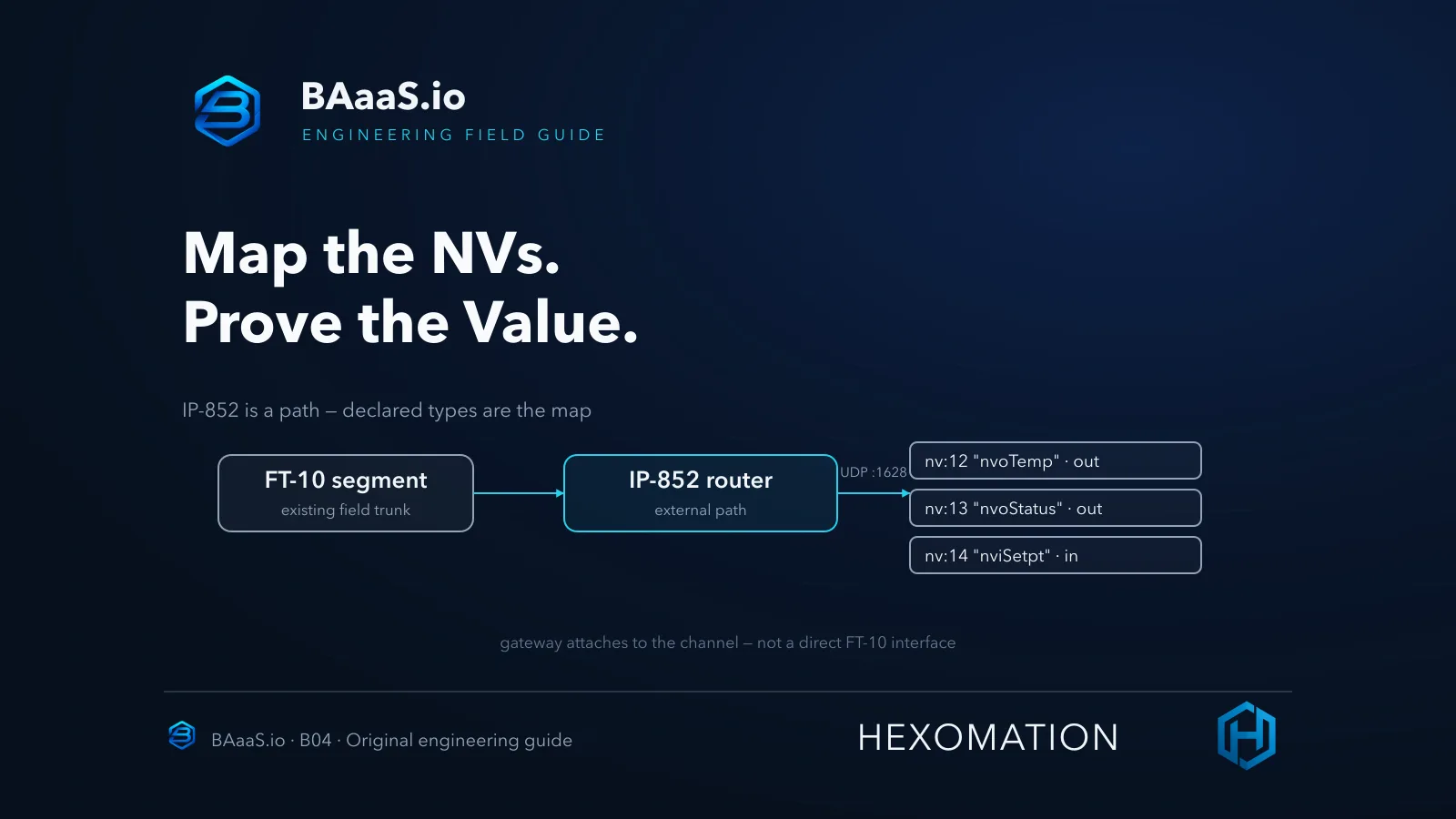
IP-852 tunnels LonWorks traffic over UDP — the gateway reaches the channel through a configured UDP port, conventionally 1628, on the right network segment. Two deployment shapes matter: the gateway can run as a member of the channel alongside an IP-852 router, or attach through a configuration-server arrangement — the mode you use depends on the site’s existing infrastructure, so confirm which the target release supports before planning the path.
And the boundary worth stating early: an existing FT-10 free-topology segment still needs its appropriate external path into IP-852 — a router or channel already in place. The gateway is not a direct FT-10 interface, and no amount of console configuration manufactures hardware that isn’t there.
That reachability check is the cheapest diagnostic in the whole workflow and the one most often skipped. If the gateway can’t reach the channel port, nothing downstream — node discovery, NV selection, values — has a chance, and every later failure will misleadingly look like a mapping problem.
Nodes first, then variables
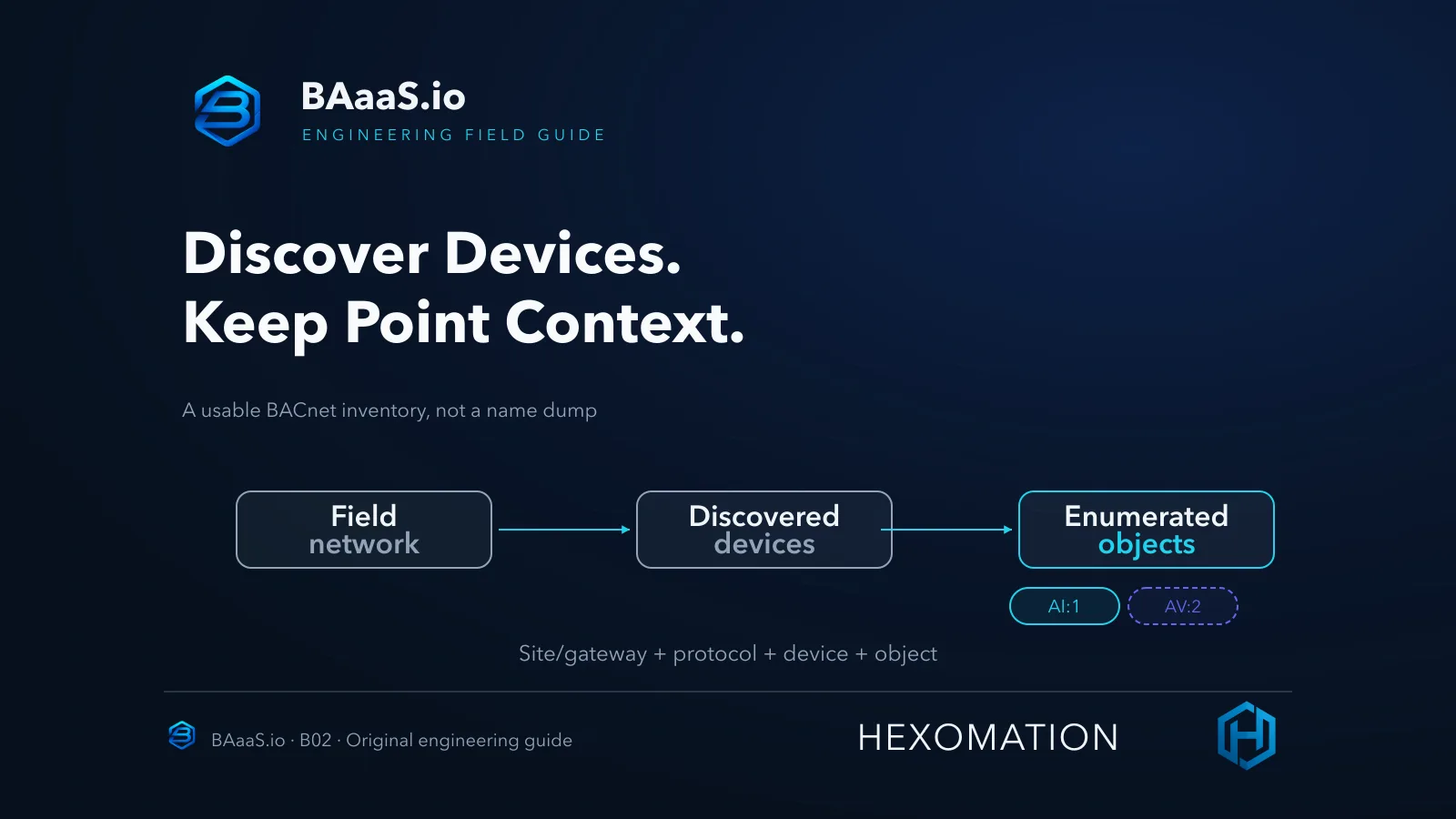
Discovery follows the same discipline as the other protocols: identify the node, then enumerate its NVs. Each NV selector — a numerical index on the node, not a display name — ties the point to a specific variable on a specific node: the LonWorks equivalent of the protocol-plus-device-plus-point identity that keeps a building full of “temperature” readings from collapsing into one ambiguous stream. Keep the selector and its alias strictly separate in your records: a label like nvoTemp is what a human calls the variable — display context only — while the selector, say the invented nv:12, is the numerical reference the node actually answers to.
Input versus output describes the variable’s direction on the node — input NVs receive data, output NVs publish it — it does not describe an operator’s read or write permission. This article reads; it does not write output NVs or alter bindings.
Discovery giving you a node list is a good moment to stop and reconcile: the nodes you expected against the nodes that answered. A missing node is usually a reachability or channel-membership issue, not a selector problem — the inventory is upstream of the map, and a selector written for a node that never joined is a mapping to nowhere.
What type decoding does — and doesn’t
SNVTs give each NV a declared type, and the platform decodes a selected set of scalar types. Two honesty rules follow. First, an unknown or structured value stays raw hex — a recognized type name on a row is not proof a complete value was decoded. Second, there are no universal numeric-conversion formulas to teach here: validate type, direction and units against the manufacturer’s NV documentation rather than assuming the wire layout.
The type-override and display-alias operations are different things and easy to conflate. An alias is display context — a label that helps operators — not a physical binding and not a decoder fix. If a value shows raw or wrong, the fix lives at the type/mapping layer; renaming the row changes what humans see, not what the wire means. Keep the raw evidence either way.
Overrides deserve the same caution: applying a declared-type override where the vendor’s layout disagrees produces a confident wrong number instead of an honest raw hex. When in doubt, capture the raw bytes and check them against the manufacturer’s document before choosing a type — an unexplained raw value is a question; a wrongly decoded one is a decision waiting to be made on bad data.
An invented retrofit, kept invented
Picture a legacy fan-coil loop: existing FT-10 trunk, an IP-852 router already serving the channel, the gateway attaching on the configured UDP path. A synthetic NV ledger might read: node FC-2F-014, selector nv:12 carrying alias “Space Temp”, declared type a scalar temperature SNVT, unit °C — invented node, invented selector, no actual values polled.
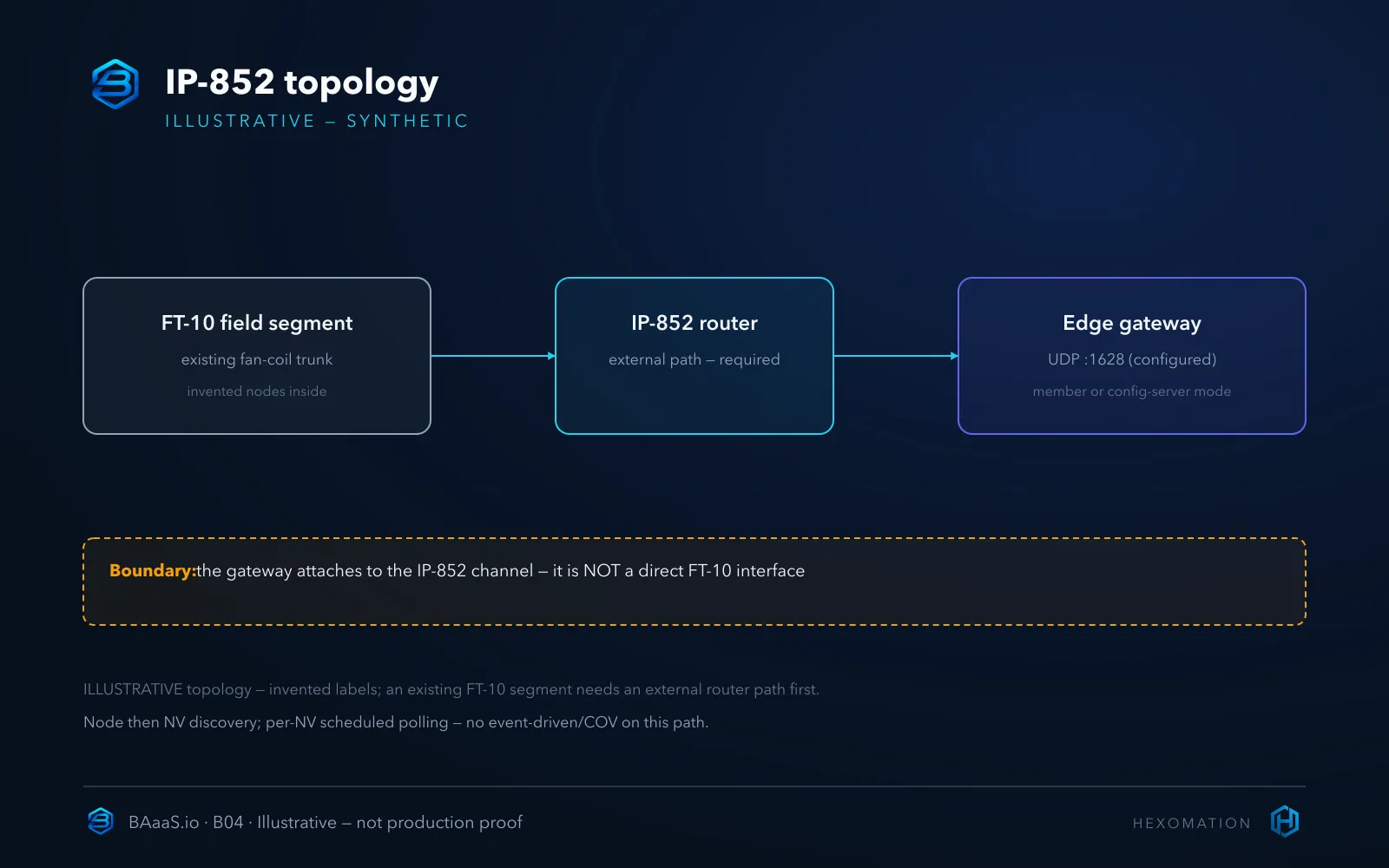
Polling is scheduled per-NV — there is no event-driven or COV collection on this path, so freshness comes from the interval you choose, not from the variable volunteering updates. That shapes the honest acceptance test below.
Choose the interval against the channel’s real capacity and the variable’s real rate of change, not a default copied from another protocol — a fan-coil temperature that drifts over minutes doesn’t need the cadence of a fault signal, and over-polling a shared channel is how retrofit projects make themselves unpopular.
Prove the value, don’t assume it
Acceptance is the same shape as every other protocol in this series: compare the polled value against the device manufacturer’s NV documentation and an independent known reference. A value that arrives is not a value that’s right — check direction (is this NV actually publishing, or expecting data?), type decode (scalar decoded or raw hex?), and units (the vendor’s stated engineering units, not the ones you hoped for).
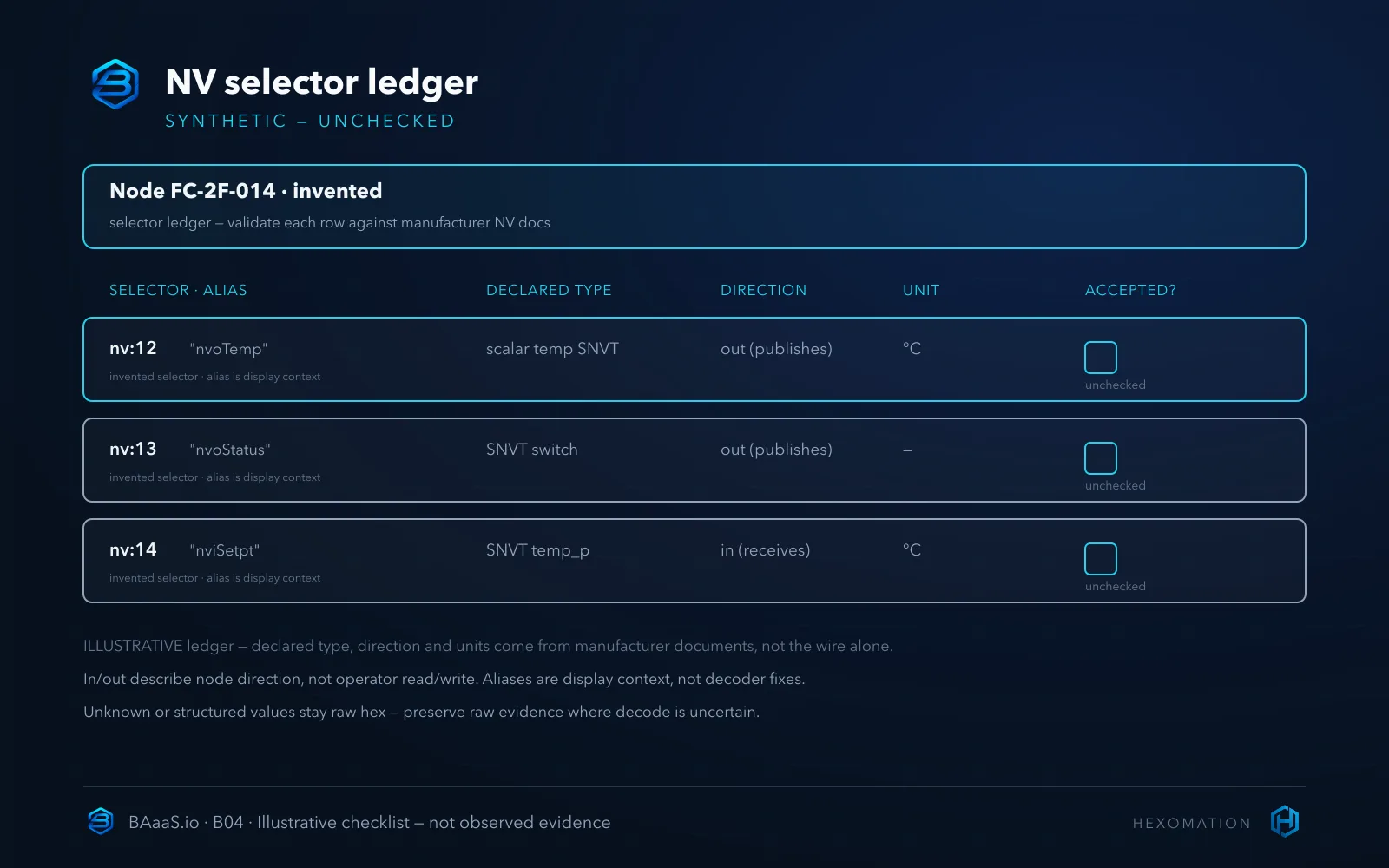
When the reference disagrees, trace in order: the channel reachability, the selector mapping, the declared type and the raw bytes behind it. Preserve the raw evidence alongside whatever the platform decoded — the disagreement is often exactly where the useful information lives.
Do that comparison for at least one NV of each type family you map. Scalar types that share a decode path can still diverge on units or direction, and a single good row is evidence about that row — not a blanket pass for the map.
The fair alternative and the limits
Where this integration earns its place is continuity: the NVs join the same monitored inventory, alarms and dashboards as every other protocol — one operations view instead of a legacy silo watched through separate tooling. Where it doesn’t replace anything is LonWorks engineering: network commissioning, binding work and deep diagnostics still belong to the vendor’s own tools, and a retrofit project that needs active binding changes is simply not a monitoring-integration job.
And the stated limits hold: no direct FT-10 hardware claim, no universal SNVT interpretation, no COV-style eventing, and no writes from this article. What you get is a readable, monitored NV inventory — which, for a lot of healthy-but-invisible LonWorks estates out there, is exactly the missing piece.
Judge the fit by what you actually need: if the estate is stable and the goal is visibility, the integration path avoids re-engineering the network; if the network itself needs surgery, the engineering tool comes first and the platform comes after.
NVs into operations, carefully
The sequence that works: confirm the IP-852 channel mode and reachability, discover nodes then NVs, map selectors to declared types and units against manufacturer documentation, validate one polled value per type family against a known reference — and keep raw evidence where decode is uncertain. Only then does monitoring mean something.
What you end up with is well worth the care: a legacy network that shows up in the same operational picture as everything newer — monitored, alarmed and trended — while the integration adds no binding or control changes. It does add polling traffic, so size the load honestly rather than claiming the network is untouched.
To assess an IP-852 retrofit on your sites, review the capability overview at BAaaS.io/features, and see how point identity survives discovery for the inventory discipline this article extends. Monitoring selection gets its own upcoming piece.